The Scope Gap: Why Two-Thirds of UK SMEs Still Can't Categorise Their Emissions

Will Marshall
Founder
As the UK Sustainability Reporting Standards move from publication into early enforcement, a foundational problem has surfaced: most small and medium-sized businesses cannot yet describe their own emissions in the language regulators and customers now expect. Recent research published by edie found that almost two-thirds of UK SMEs do not understand how to categorise their emissions into Scopes 1, 2 and 3, the same framework that underpins every major sustainability disclosure rule arriving over the next eighteen months. This article unpacks what that gap means, why supply-chain pressure makes it urgent, and what businesses can do about it before requests start landing in their inboxes.
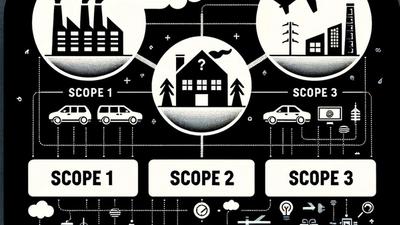
What Scopes 1, 2 and 3 Actually Mean
The scope framework comes from the Greenhouse Gas Protocol, the international standard that defines how organisations measure carbon. It splits emissions into three categories based on where they are produced and who controls them.
- Scope 1: Direct emissions from sources an organisation owns or controls, such as company vehicles, gas heating, or on-site fuel use.
- Scope 2: Indirect emissions from purchased energy, mainly electricity, district heating, or steam consumed on site.
- Scope 3: All other indirect emissions across the value chain, including business travel, employee commuting, purchased goods and services, and the use of products sold.
For most service-based SMEs, Scope 3 accounts for the largest share of the carbon footprint, despite being the hardest to measure. That is precisely why it has become the central focus of supply-chain reporting. For a fuller breakdown of each category, see our guide to Scope 1, 2 and 3 carbon emissions.
Why the Knowledge Gap Matters Now
The UK Sustainability Reporting Standards (UK SRS) were officially published on 25 February 2026, replacing a patchwork of TCFD references, SECR rules, and voluntary frameworks with a single coherent set of disclosure requirements. The Financial Conduct Authority is consulting on phased mandatory reporting under the UK Listing Rules from 1 January 2027, with consultations on the largest unlisted UK entities expected later in 2026.
Smaller businesses are not directly in scope. The problem is what happens to the data demands of every company that is. Large customers preparing UK SRS-aligned disclosures need accurate Scope 3 figures from across their supply base, which means their suppliers, however small, will be asked for emissions data. Without an understanding of the scope framework, SMEs cannot answer those requests credibly.
The Supply Chain Pressure SMEs Cannot Avoid
Research published by edie this spring also confirmed that a significant share of UK SMEs feel underprepared for the new EU and UK reporting environment. The pressure is no longer theoretical. Procurement teams at listed firms, banks and public-sector buyers are already issuing ESG questionnaires, and tender documents increasingly include scope-level emissions data alongside price and quality.
The risk for unprepared SMEs is twofold. First, contracts may be lost to suppliers that can demonstrate measurement maturity. Second, customers may use sector averages or estimated proxies in place of supplier-reported numbers, which can overstate a small business's carbon footprint and harm its competitive position. Accurate measurement, even at a basic level, is now a commercial asset.
The Skills Shortage Making It Worse
The data on workforce capacity reinforces how serious the situation has become. According to recent UK skills analysis, demand for sustainability expertise is outpacing supply by roughly two to one, leaving the country with an estimated shortfall of 200,000 green-skilled workers. That gap sits at every level of the economy, from sustainability managers in large firms to bookkeepers and operations staff in SMEs who are quietly being asked to take on emissions reporting as an additional duty.
For smaller businesses, hiring a dedicated sustainability lead is rarely realistic. The more practical response is to upskill the staff already in place, so that operations, finance and procurement teams share a working understanding of what scopes mean and how data is gathered. This is the gap that workplace climate education, including Carbon Literacy Training, is designed to close.
The Opportunity Inside the Pressure
It would be misleading to frame this purely as a compliance burden. The same period has seen the UK net zero economy expand sharply. According to CBI and ECIU analysis, the sector grew 10.1% in gross value added since 2023, with SMEs making up 94% of the 22,800 net zero businesses identified and the wider supply chain supporting almost 951,000 jobs.
Businesses that learn the language of scopes early are better placed to win procurement work, access green finance products, and identify cost savings in energy and travel that would otherwise stay invisible. Measurement is not only a regulatory requirement; it is the precondition for any credible reduction strategy.
Practical Steps for SMEs This Year
For SMEs facing inbound data requests for the first time, a small number of foundational steps go a long way:
- Map operations to scopes: List every fuel, energy and travel cost line in the accounts and assign each to Scope 1, 2 or 3. Most small businesses can complete this exercise in a single afternoon.
- Start with utility data: Annual electricity and gas use, fleet fuel records, and travel expenses cover the majority of Scope 1 and 2 emissions and the simplest part of Scope 3.
- Build internal capability: Train at least one person in each of finance, operations and procurement on emissions fundamentals, so the knowledge does not sit with a single individual.
- Document the methodology: Customers care less about perfection than about consistency. A clear record of how figures were calculated builds trust during audits.
- Use a recognised tool: Free carbon calculators tailored to SMEs reduce the risk of inconsistent units and double counting.
While these steps will not deliver UK SRS-grade disclosure on day one, they put a business in a credible position to respond to its largest customers without delay.
The Path Forward
The scope gap is not a permanent feature of the UK SME economy; it is a temporary mismatch between the speed of regulatory change and the speed of workforce learning. Closing it does not require hiring sustainability specialists. It requires giving the people already inside a business the vocabulary and confidence to talk about emissions in the terms their customers, banks and regulators are now using as standard.
The SMEs that act this year, while the requirements are still indirect, will spend 2027 winning contracts rather than scrambling to answer overdue questionnaires.
Kickstart your journey into sustainable growth, with all the tools you need to get going at Bright.